- Main
- News
- The Faculty of Philosophy and Political Science Held a Meeting with Prominent Philosopher Ualikhan Tuleshov
The Faculty of Philosophy and Political Science Held a Meeting with Prominent Philosopher Ualikhan Tuleshov
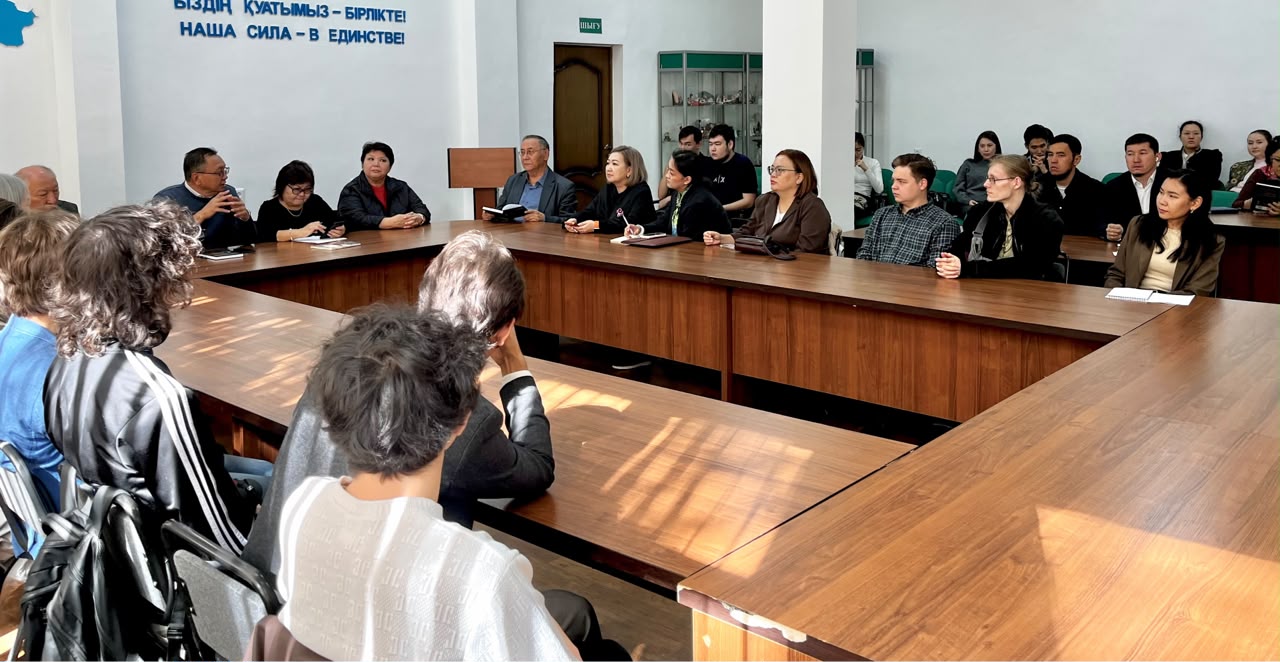
On October 2, 2026, the Faculty of Philosophy and Political Science of Al-Farabi Kazakh National University held a meeting with prominent philosopher and researcher Walikhan Tuleshov entitled “How I Came to Texturalism.”
The main purpose of the meeting was to discuss contemporary developments in philosophical thought, the transformation of cultural paradigms, and new conceptual approaches to understanding the contemporary world.
During the meeting, Walikhan Tuleshov spoke about his intellectual and philosophical journey and the theoretical premises that led to the development of the concept of texturalism. Particular attention was given to the philosophical interpretation of contemporary sociocultural transformations and the search for new theoretical frameworks capable of addressing the complexity and multidimensionality of present-day reality.
The discussion focused on post-globalization as a new ontological stage. Within this framework, modernity and postmodernism were examined as cultural paradigms whose established explanatory models face new challenges in interpreting a rapidly changing social and cultural reality.
In this context, texturalism was presented as a distinctive conceptual approach aimed at understanding the world as a combination of multiple, multilayered, and mutually complementary realities. Such an approach makes it possible to examine different dimensions of human existence, culture, and society not in isolation, but through their interconnections and interactions.
Particular attention was also devoted to the transformation of human worldviews, changes in cultural forms, the role of philosophy in interpreting contemporary social processes, and the relationship between globalization, post-globalization, and new ways of constructing meanings.
Students and faculty members actively participated in the discussion, asked questions, and exchanged views. Particular interest was generated by questions concerning the relationship between texturalism and postmodernism, its ontological foundations, and the potential of this approach for analysing contemporary culture.
Such meetings provide an important space for open philosophical dialogue, contribute to the development of students’ critical thinking, and help connect academic knowledge with актуal issues in contemporary culture and society.
At the conclusion of the meeting, the participants expressed their appreciation to Walikhan Tuleshov for the insightful presentation, open dialogue, and opportunity to become acquainted with his philosophical journey and conceptual ideas.
Other news