- Main
- News
- International Symposium “Genetics and Breeding: From Scientific Heritage to Future Frontiers” at Al-Farabi Kazakh National University: Contributing to the UN SDG and Advancing Interdisciplinary Research
International Symposium “Genetics and Breeding: From Scientific Heritage to Future Frontiers” at Al-Farabi Kazakh National University: Contributing to the UN SDG and Advancing Interdisciplinary Research
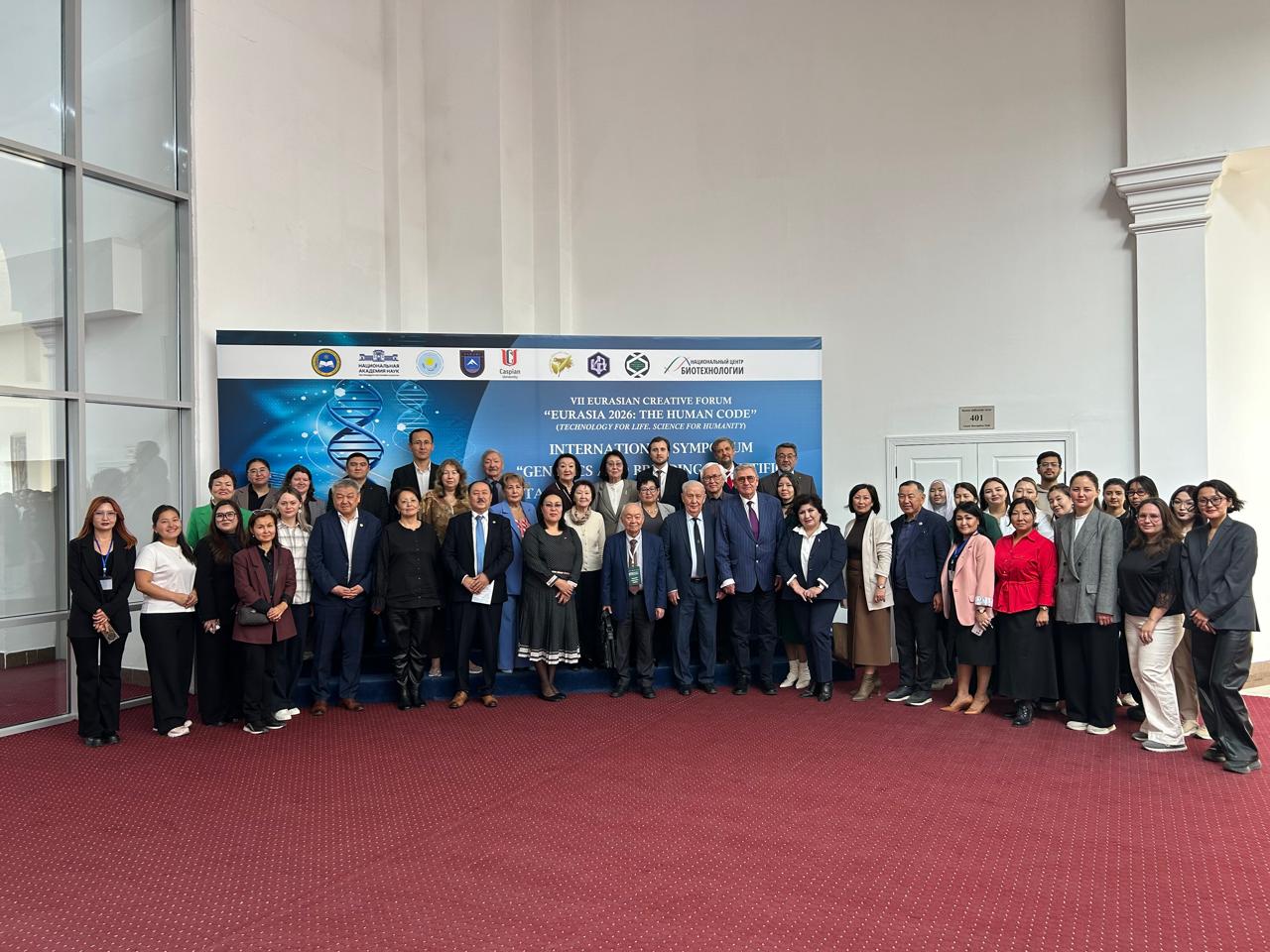
Al-Farabi KazNU hosted the international symposium “Genetics and Breeding: From Scientific Heritage to Future Frontiers,” organized by the Department of Molecular Biology and Genetics of the Faculty of Biology and Biotechnology in collaboration with RSI of Biology and Biotechnology Problems and RSIof Environmental Sustainability and Bioresources, in partnership with Caspian University.
The event focused on current scientific achievements and future prospects in genetics, breeding, molecular biology, and biotechnology, while emphasizing the continuity of scientific traditions. The symposium brought together researchers, university faculty members, and specialists working across diverse fields of the biological sciences. It provided a platform for the exchange of research findings, discussion of interdisciplinary approaches, and the strengthening of international academic cooperation. The symposium was conducted in a hybrid format, enabling participants to engage in scientific discussions both in person and online.
As part of the symposium, a signing ceremony was held for a cooperation agreement between the N.I. Vavilov Institute of General Genetics of the Russian Academy of Sciences, Al-Farabi Kazakh National University, and the Institute of Cytology and Genetics of the Siberian Branch of the Russian Academy of Sciences. The agreement provided for the establishment of the Scientific Center for Neuromicrobiome and the organization of its activities.
Leading scientists and early-career researchers from Kazakhstan, Russia, France, Switzerland, and Bulgaria delivered scientific presentations.
The plenary session featured presentations on the history of the establishment of the Kazakhstan Society of Geneticists and Breeders, the paleogenetic analysis of archaeological finds, and the application of DNA markers in crop breeding. Particular attention was devoted to the investigation of transcription using Drosophila as a model organism, ecological and genetic monitoring of areas affected by human-induced environmental disturbance, genetic and epigenetic technologies, and the prospects for programmable mitochondrial delivery.
During the parallel session, participants discussed the use of bacterial biosensors to assess the toxicity and genotoxicity of chemical compounds, the application of biochar in the remediation of contaminated soils, molecular genetic analysis of bacteria, and approaches to enhancing the accumulation of biologically active compounds in plant cell and tissue cultures.
The scientific programme demonstrated the importance of integrating fundamental research with applied development to address pressing challenges in agriculture, environmental protection, and medical technologies.
The symposium contributed to the advancement of UN Sustainable Development Goal (SDG) 3, “Good Health and Well-Being”; SDG 15, “Life on Land”; and SDG 17, “Partnerships for the Goals.” It underscored the role of international scientific collaboration in advancing sustainable innovation.
Department of Molecular Biology and Genetics
Other news