- Main
- News
- “A Financially Literate Generation Is the Foundation of a Stable Society” — An Interfaculty Lecture
“A Financially Literate Generation Is the Foundation of a Stable Society” — An Interfaculty Lecture
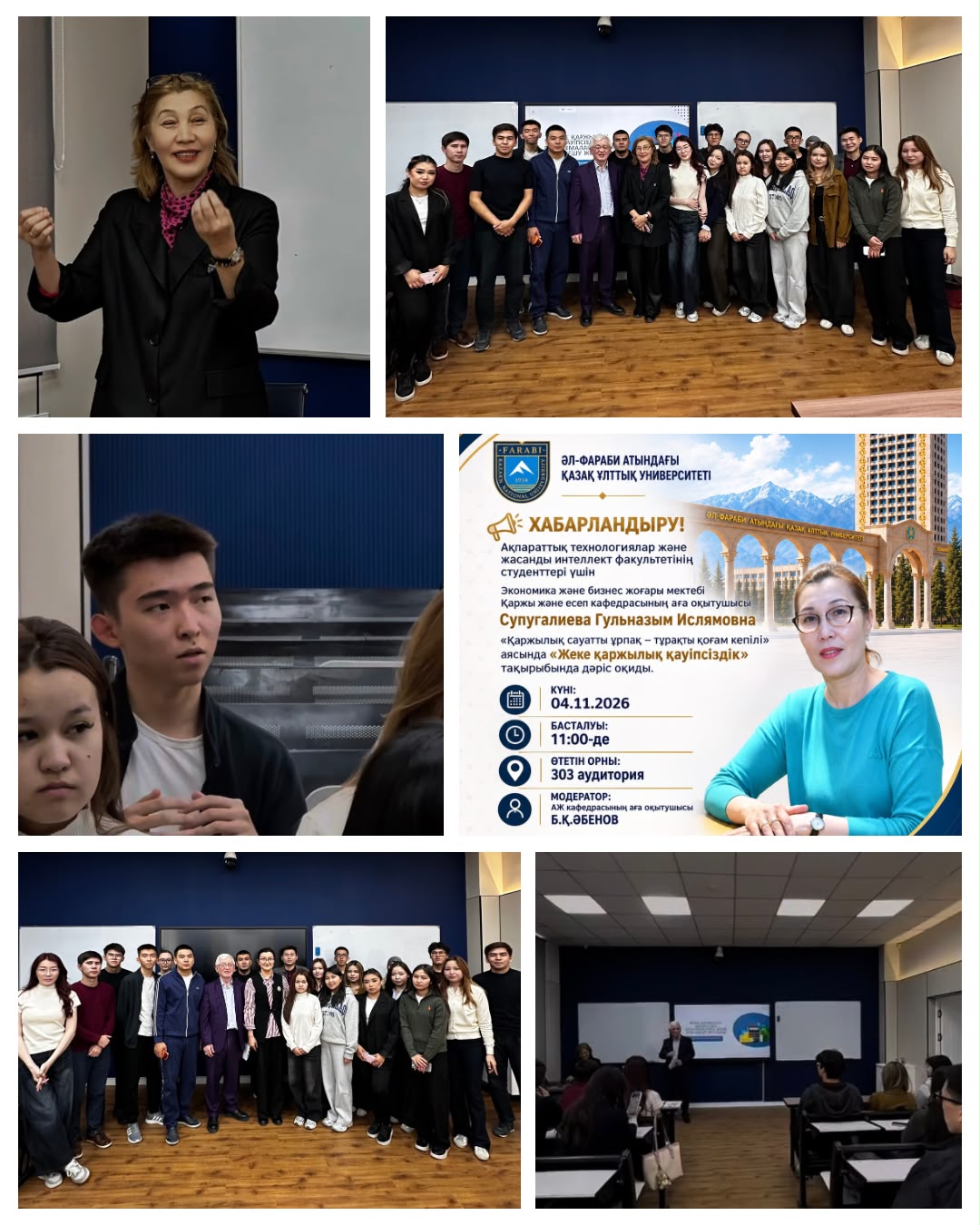
On November 4, 2026, at 11:00 a.m., G. I. Supugaliyeva, Senior Lecturer at the Department of Finance and Accounting of the Higher School of Economics and Business, delivered a lecture on “Personal Financial Security” for students of the Faculty of Information Technology and Artificial Intelligence. The lecture took place in Room 303.
The educational lecture was organized in accordance with Sustainable Development Goal 8 (SDG 8) — “Decent Work and Economic Growth,” which aims to promote sustainable economic development, increase employment, and create conditions for decent work.
Educating students on personal financial security, particularly through lectures, is one of the key priorities outlined in the President's Address. The document places particular emphasis on the “Debt-Free Society” (Qaryzsyz Qogam) project, which is aimed at improving financial literacy. Through this initiative, the President seeks to foster a culture of financial responsibility among the population, with particular attention to overcoming excessive dependence on credit.
Thus, improving students' financial literacy is an important step that responds to current societal needs and prepares the younger generation to achieve personal financial stability. Students will learn not only how to manage their financial resources effectively but also how to systematically increase their capital, set financial goals, and identify specific steps necessary to achieve them.
Personal financial security is a fundamental prerequisite for a stable life and confident future planning. It enables individuals to maintain financial stability, prepare for unforeseen circumstances, and avoid financial dependence.
The main financial risks include unstable income, a lack of savings, excessive debt, financial fraud, insufficient investment literacy, and inflation. These factors significantly affect an individual's financial well-being and stability.
To ensure financial security, individuals need to engage in conscious financial planning, monitor their income, build savings, manage debt effectively, improve their financial literacy, and maintain financial discipline. Therefore, financial literacy and responsibility serve as the foundation for a secure, reliable, and stable life.
The lecture was engaging and interactive, incorporating practical examples and discussions of real-life situations. Students actively participated in discussions, which increased their interest in the topic, developed their analytical and critical thinking skills, and contributed to the acquisition of practical financial management skills.
The main objectives of the lecture were as follows:
To develop students' knowledge and skills in saving and preserving financial resources;
To teach students how to spend money effectively and responsibly;
To help students understand the sources and structure of their financial resources, including income sources, total savings, investments, debts, and other financial obligations.
Furthermore, the lecture included exercises related to economic and financial issues. Particular attention was paid to the nature of suspicious financial organizations, including the reasons for their emergence, their structure, and their operating mechanisms. The lecture also addressed key financial challenges, methods of ensuring personal financial security, and criteria for assessing an individual's level of financial security.
In this context, financial literacy helps students contribute to the achievement of the Sustainable Development Goals while successfully pursuing their aspirations for quality education.
In other words, the better students understand both basic and advanced economic concepts, the more clearly they recognize opportunities to improve their future quality of life.
Financial literacy is one of the essential components contributing to the achievement of quality education. Financial literacy lectures at universities are particularly important because they teach students how to manage money effectively, prepare personal budgets, build savings, and develop responsible financial behavior.
These skills and competencies are valuable not only for individual financial well-being but also for the development of a financially resilient and economically stable society.
Other news