- Main
- News
- Artificial Intelligence Creates New Opportunities for Professions and Human Capital Development
Artificial Intelligence Creates New Opportunities for Professions and Human Capital Development
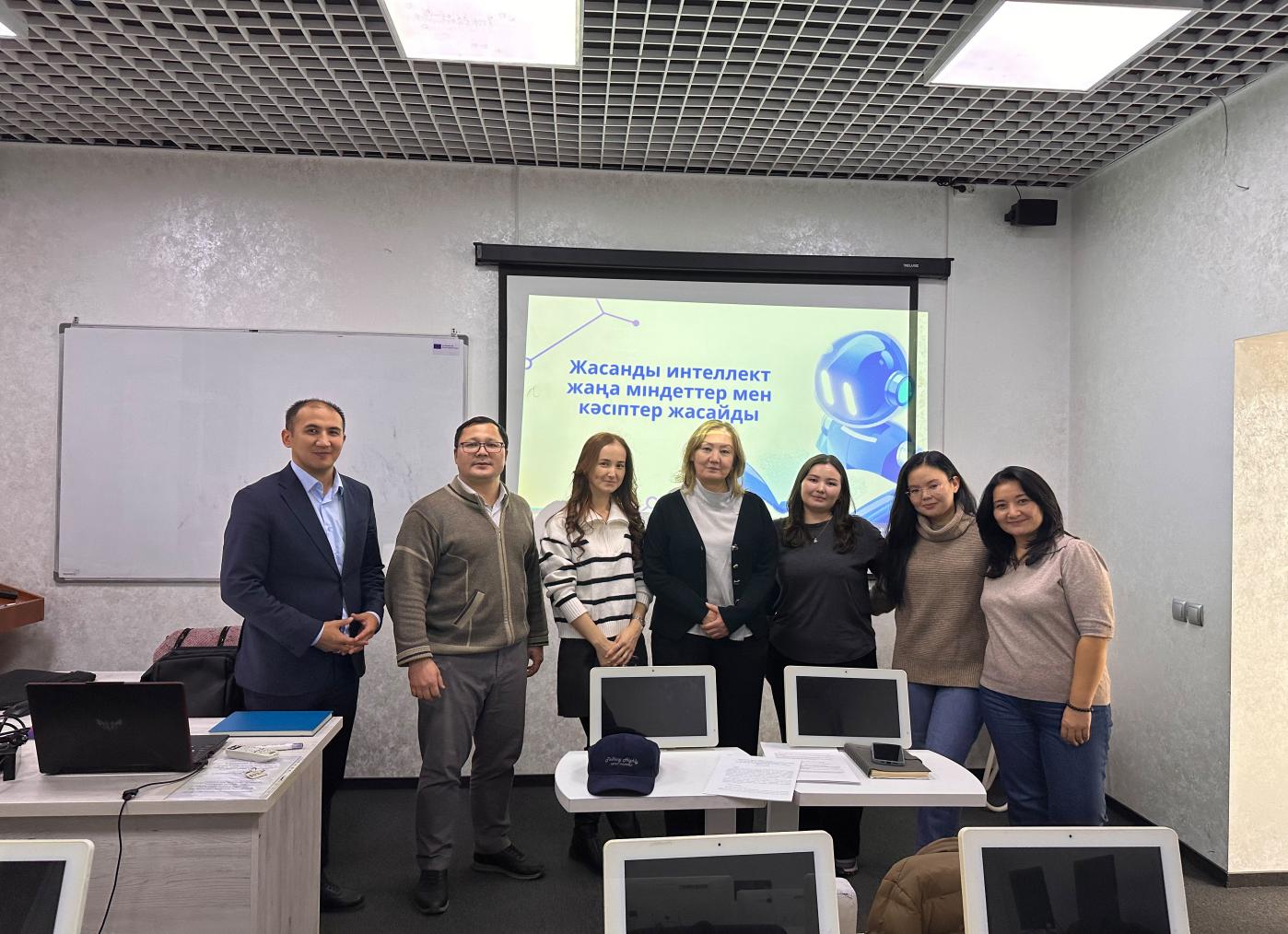
On November 11, 2026, a significant scientific and practical seminar-discussion addressing one of the most pressing topics of our time took place at the Higher School of Economics and Business of Al-Farabi Kazakh National University. The event was held under the theme “Artificial Intelligence Creates New Tasks and Professions.” The primary objective of the meeting was to thoroughly examine the strategic role of human capital amid rapid global digital transformation and to comprehensively assess the impact of advanced technologies on labor market dynamics, economic growth, and national competitiveness within the framework of the UN Sustainable Development Goals (SDGs) and ESG (Environmental, Social, and Governance) principles. The seminar brought together leading faculty members, professors, experts, and first-year PhD doctoral students from the Economics educational program, who shared their analytical insights and practical research findings.
During the engaging discussion, representatives of the Department of Economics noted that the active integration of artificial intelligence (AI) technologies across various sectors of economic activity is fundamentally reshaping traditional employment structures. The speakers emphasized that while automation replaces routine and repetitive tasks, this process simultaneously stimulates the emergence of entirely new professional fields requiring deep analytical thinking, creativity, and advanced digital literacy. Participants agreed that the popular notion suggesting “AI will completely replace humans” is overly simplistic; a more accurate premise in contemporary realities is that “a professional utilizing AI will replace a professional who does not.” This approach significantly boosts labor productivity and drives structural efficiency across the economy.
The academic debate was closely aligned with the core priorities of the United Nations Sustainable Development Goals. Specifically, participants explored several key areas: SDG 4 (Quality Education): Discussions focused on modernizing university curricula, integrating intelligent tools and Big Data analytics into the educational process, and fostering critical thinking and research skills among students and young researchers. SDG 8 (Decent Work and Economic Growth): The impact of digitalization on labor productivity was analyzed alongside flexible mechanisms for workforce adaptation, lifelong learning, and professional reskilling for the jobs of the future. SDG 9 (Industry, Innovation, and Infrastructure): Speakers highlighted the critical importance of strengthening robust ties between academic science, higher education, and the real sector of the economy to build a thriving domestic innovation ecosystem.
Special emphasis during the seminar was placed on the Social and Governance dimensions of ESG standards. Participants addressed ethical responsibilities in developing and deploying AI algorithms, ensuring information security and personal data privacy, maintaining algorithmic transparency, and preventing digital inequality in society. Environmental sustainability aspects achieved through resource optimization were also touched upon, alongside the vital need to maintain a harmonious balance between technological progress and fundamental human values.
In conclusion, the seminar participants summarized that the responsible and ethical adoption of artificial intelligence in education and scientific research serves as a cornerstone for sustainable economic growth. Hosting such prestigious academic platforms once again reaffirms Al-Farabi Kazakh National University’s leading role in advancing the Sustainable Development Goals and training highly competitive, next-generation specialists equipped to address the complex challenges of the digital era.
Organizers: L.A. Bimendieva, D.R. Turarov, and first-year doctoral students of the Economics educational program.
Date of Event: November 11, 2026.
Other news