An excursion to the Citrus House was organized within SDG 15 “Life on Land”
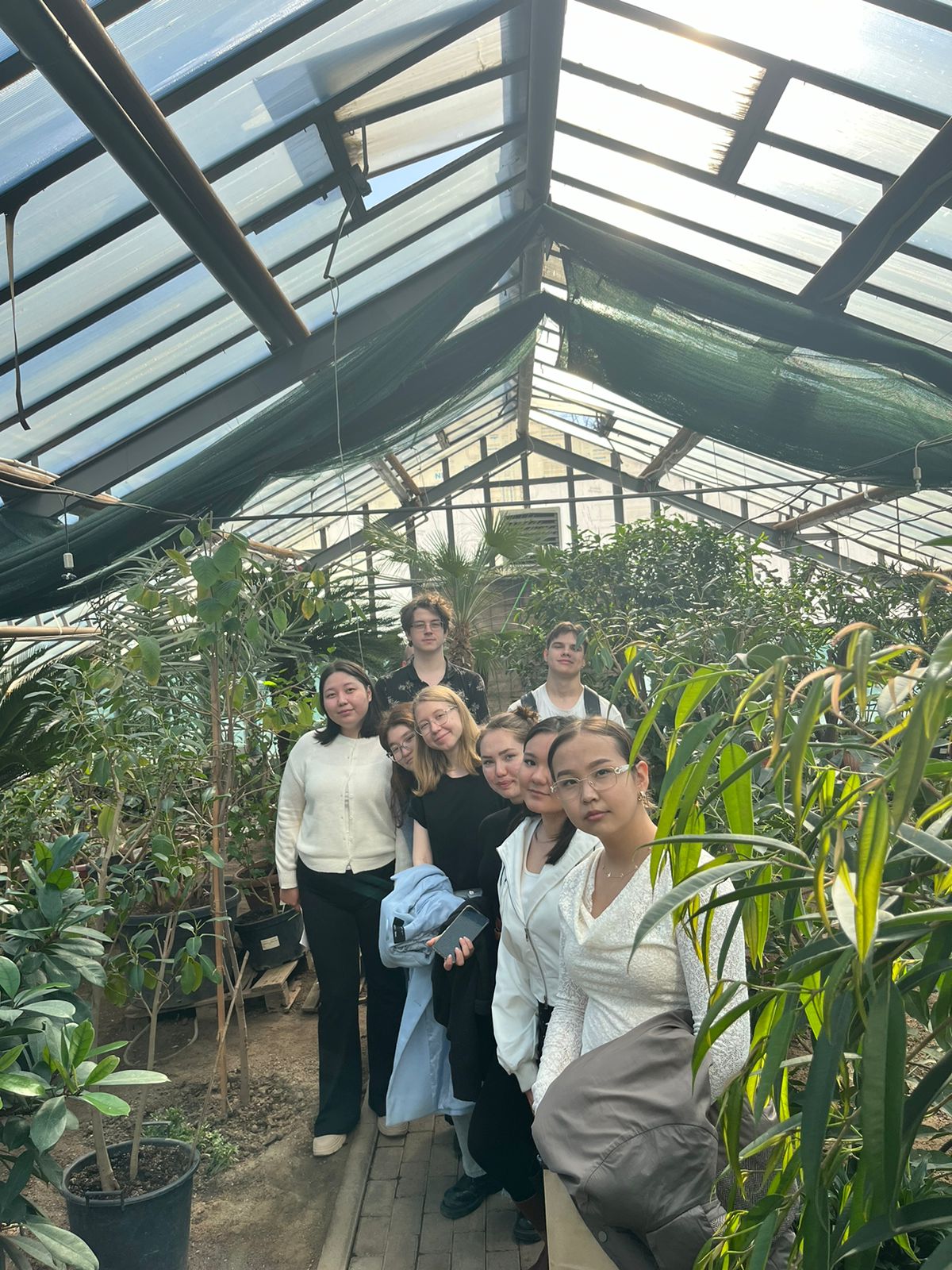
From 19 to 23 March 2026 (according to the agreed schedule), an educational excursion was organized for 24 students of the 6B05105 – Genetics program at the Botanical Garden of the Institute of Botany and Phytointroduction. The theme of the visit was “Introduction and Conservation of Citrus Crops under Protected Cultivation as a Contribution to Biodiversity Conservation.” The main venue was the Citrus House (a protected-cultivation greenhouse). Each session was held from 12:00 to 13:00. The activity used living collection specimens of citrus plants, visual posters and schemes, methodological handouts and observation sheets, and photo documentation.
The excursion was linked to the UN Sustainable Development Goals, primarily SDG 15 “Life on Land,” with an emphasis on conserving terrestrial biodiversity and supporting the stability of plant genetic resources. Participants discussed why protected botanical collections are an effective ex situ mechanism for safeguarding valuable genotypes, especially under climate change, land degradation, and habitat loss. The guide also demonstrated the scientific principles of plant introduction and acclimatization in temperate Kazakhstan, explaining the role of greenhouse microclimate management (temperature, humidity, light, irrigation, and ventilation) and the importance of phytosanitary monitoring.
During the practical component, students conducted guided observations of Citrus representatives and completed a structured morphological analysis. They described leaf shape and texture, shoots and thorns, flower traits, and fruit characteristics, and compared several species/varieties using observation criteria. Short discussion prompts helped students connect environmental factors to adaptation mechanisms and identify potential risks for introduced collections (pests, diseases, and resource costs). A dedicated block, aligned with the Genetics curriculum, focused on grafting as a key technique for preserving elite genotypes, improving resilience, and maintaining genetic diversity in living collections.
.jpeg)
Before entering the greenhouse, students received a brief safety and conduct briefing: no touching plants without permission, no removal of plant parts, no crossing restricted zones, and no interference with greenhouse equipment. Participants worked in small teams of 4–6 and rotated through short “stations” on microclimate, morphology, introduction risks, and specimen documentation (labeling and passportization). The session ended with reflection and a short Q&A, where students summarized success factors for introduction, articulated the role of botanical gardens in SDG 15 implementation, and proposed concrete examples of personal and professional contribution to sustainable development as future geneticists. Collected observation sheets were reviewed, and the outcomes were incorporated into the students’ academic portfolios.
Department of Botany and Agroecology