- Main
- News
- The Role of Education in Modern Society: Knowledge, Skills, Opportunities and Economic Well-being
The Role of Education in Modern Society: Knowledge, Skills, Opportunities and Economic Well-being
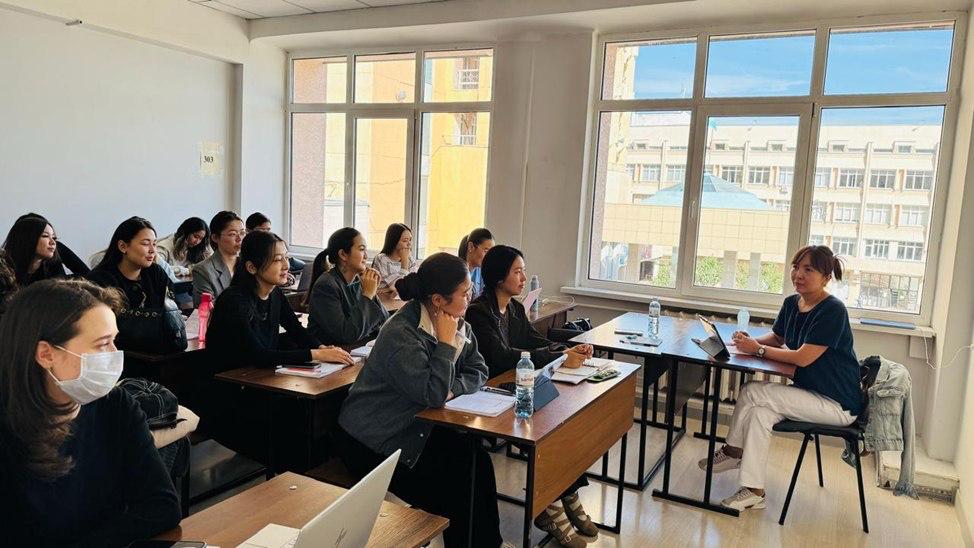
On September 29, 2026, fourth-year students majoring in “6B02303 - Foreign Philology (Western languages)” of the Department of Foreign Philology and Translation Studies of the Faculty of Philology of Al-Farabi Kazakh National University participated in an open lesson on the topic “The Role of Education in Modern Society: Knowledge, Skills, Opportunities and Economic Well-being.” The lesson was conducted within the framework of the Sustainable Development Goals (SDGs), with particular focus on SDG 4 “Quality Education”.
The lesson aimed to develop students’ advanced English communication, critical thinking, analytical reasoning, and argumentation skills while exploring the role of education in contemporary society. Students discussed education not only as a means of acquiring knowledge but also as an important factor in developing professional skills, creating employment opportunities, promoting social mobility, and improving individual and economic well-being.
During the lesson, students examined the changing role of education in the 21st century and analysed the relationship between education, employment, income, and quality of life. Particular attention was given to transferable skills, digital literacy, creativity, communication, adaptability, and lifelong learning as essential competencies in a rapidly changing labour market. Students also discussed challenges related to equal access to quality education, including socioeconomic background, technological inequality, and differences in educational opportunities.
The central part of the lesson involved interactive group discussions and analytical tasks. Students considered whether higher education remains essential for professional success, whether academic qualifications guarantee employment and economic well-being, and how education can contribute to reducing social inequalities. They presented arguments, responded to opposing viewpoints, and supported their positions with relevant examples.
The lesson concluded with a reflection on the statement “Education is not only a pathway to knowledge, but also a pathway to opportunity and economic well-being.” The open lesson demonstrated active student participation and contributed to the development of academic speaking, critical thinking, argumentation, collaborative communication, and professional English skills. It also enhanced students’ understanding of education as a key driver of personal development, social equality, employment, and sustainable economic growth.
Department of Foreign Philology and Translation Studies
Assistant Professor Kenzhekanova K.K.
Other news