- Main
- News
- Open Lesson “Cultural Salon: Cuisine of the Great Silk Road” Held at the Faculty of Oriental Studies
Open Lesson “Cultural Salon: Cuisine of the Great Silk Road” Held at the Faculty of Oriental Studies
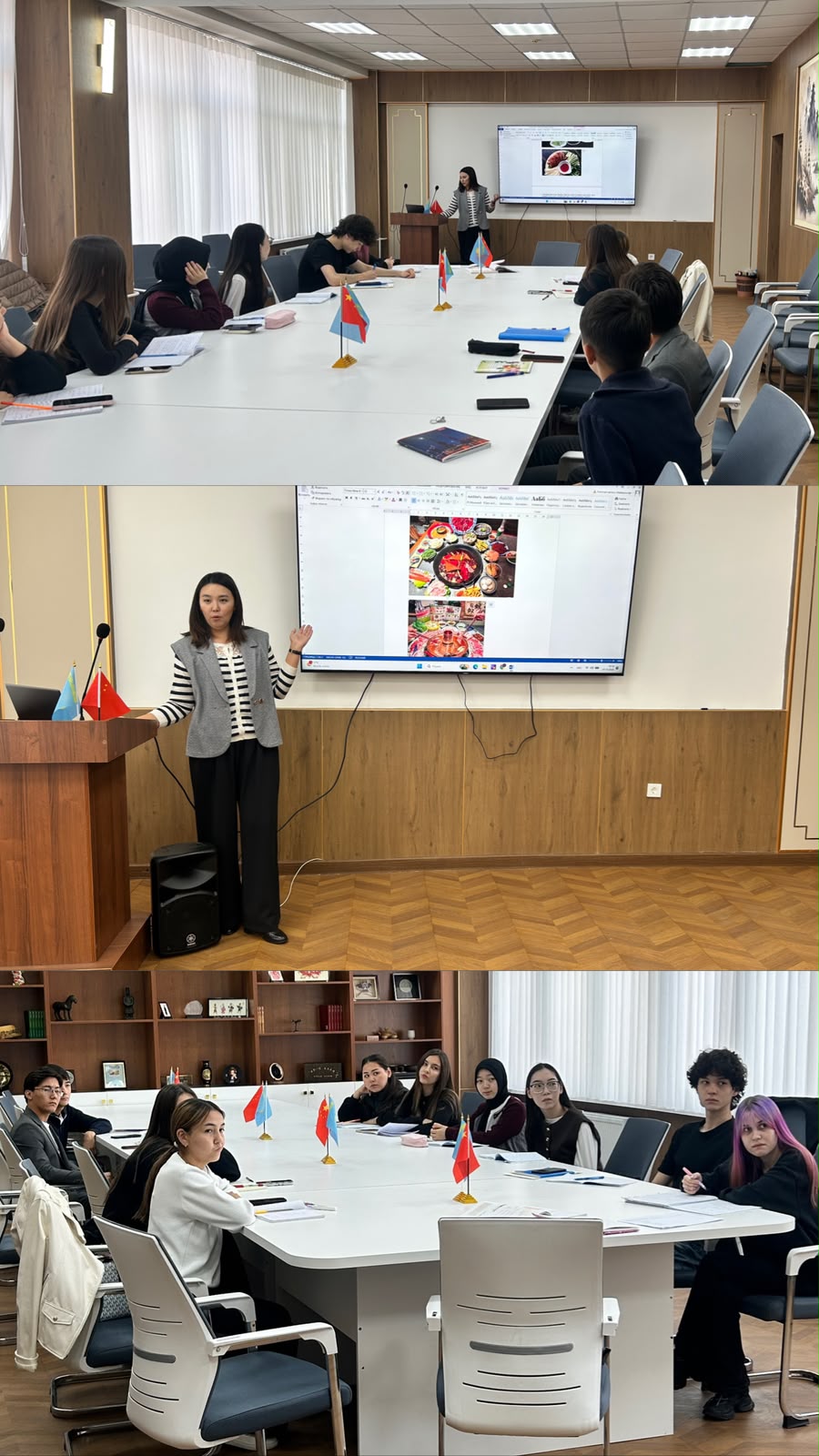
On October 9, 2026, the Faculty of Oriental Studies at Al-Farabi Kazakh National University hosted an open lesson entitled “Cultural Salon: Cuisine of the Great Silk Road.” The event was organized as part of the activities of the “Great Silk Road” Club under the Department of Chinese Studies and focused on Chinese culinary culture and its role in the history of intercultural contacts across the Great Silk Road.
The open lesson was conducted by Kunbai Zhuldyzai, with overall coordination provided by Dusenbai Kulpynai, Head of the Club.
The main focus of the lesson was traditional Chinese culinary culture. Students explored the distinctive features of four major regional culinary traditions: Shandong, Sichuan, Jiangsu, and Guangdong, examining their regional characteristics, commonly used ingredients, and traditional cooking techniques.
Particular attention was paid to the Great Silk Road as an important space for trade and cultural interaction among different peoples. Contacts between various regions facilitated the exchange of food products, culinary technologies, and gastronomic traditions, which over time became part of the cultural heritage of different societies.
As part of the lesson, students also compared the culinary traditions of China and the peoples of Central Asia, discussing similarities and differences between national dishes, the use of ingredients, and traditional cooking methods. This approach allowed culinary culture to be considered not only as an element of everyday life, but also as an important component of historical memory, cultural identity, and intercultural dialogue.
The open lesson included thematic presentations, visual materials, a question-and-answer session, interactive activities, and group discussions. The active participation of students contributed to a deeper understanding of the material and helped develop their intercultural communication skills.
The event became one of the educational and cultural initiatives organized by the “Great Silk Road” Club to broaden students’ knowledge of Chinese culture and the history of international contacts in Central Asia. The open lesson contributed to increasing students’ interest in China’s cultural heritage and highlighted the significance of the Great Silk Road as a historical space of dialogue and mutual cultural influence.
The event combined educational and cultural-enlightenment components, demonstrating the importance of culinary heritage as an accessible and meaningful tool for studying the history and culture of the peoples of the Great Silk Road.
Other news