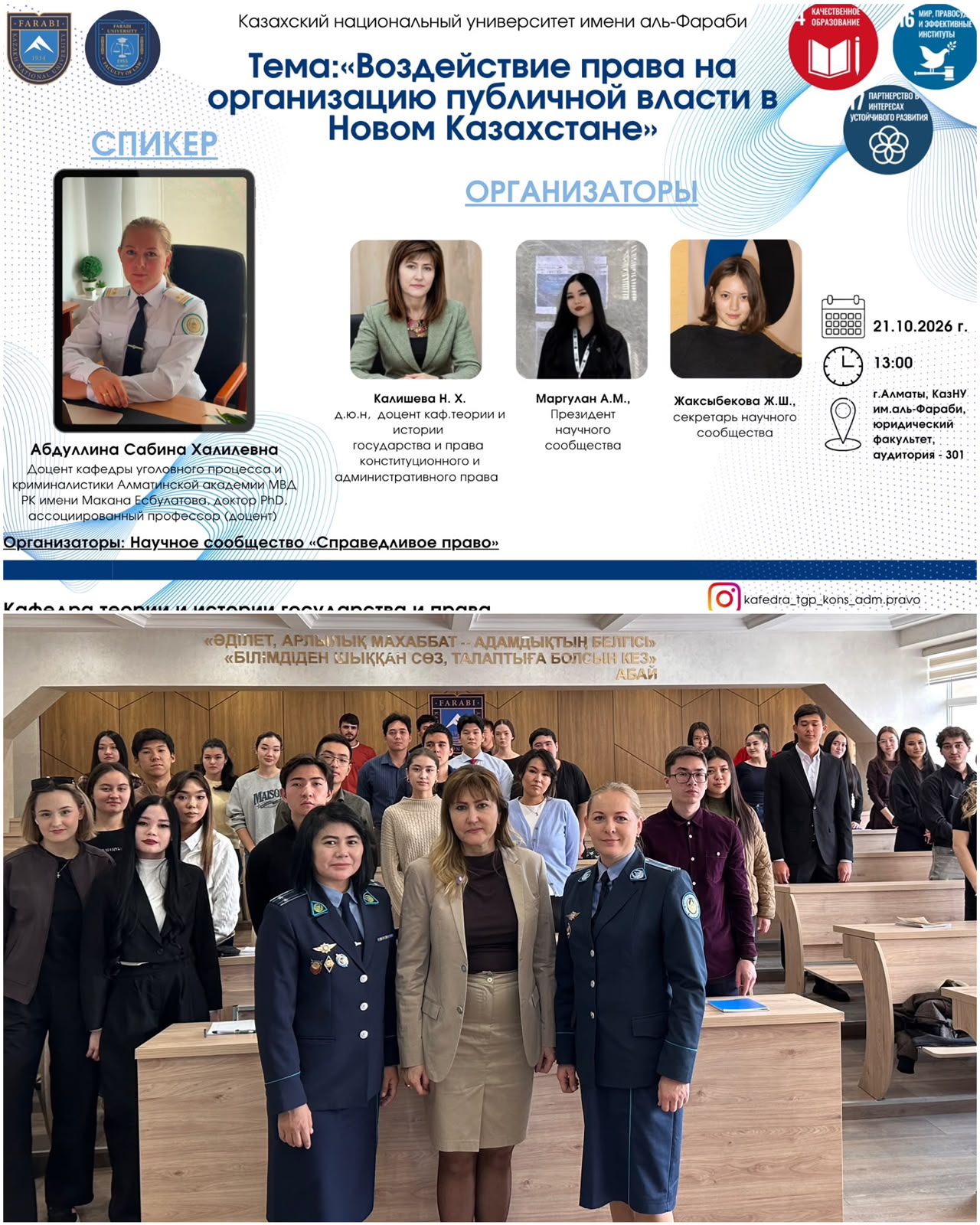
As part of the events planned by the leading Department of Theory and History of State and Law, Constitutional and Administrative Law of the Faculty of Law of Al-Farabi Kazakh National University, and held in pursuit of SDG 16, on 21 October 2026 an event entitled "The Impact of Law on the Organization of Public Authority in New Kazakhstan" was organized and held for final-year bachelor's students of the Faculty of Law. It was led by Senior Lecturer of the Department, Doctor of Law, Associate Professor N.Kh. Kalisheva, with the participation of active members of the "Just Law" scientific community: third-year Jurisprudence students A. Margulan, Zh. Zhaksybekova, K. Kanayeva, A. Umarova, N. Imanbayev, T. Beisimbayev, M. Khamitova, and Zh. Ablazimov. It is symbolic that the event was also held within the framework of SDG 4 (quality of teaching and learning).
The invited speakers were Sabina Khalilovna Abdullina, Associate Professor of the Department of Criminal Procedure and Criminalistics at the Makan Yesbulatov Almaty Academy of the Ministry of Internal Affairs of the Republic of Kazakhstan, PhD, Associate Professor, and Aida Asylbekovna Daetova, third-year doctoral student of the same department.
One of the priorities voiced at the event was the need to strengthen law and order. As is well known, Head of State K.-J.K. Tokayev has emphasized the principle of zero tolerance toward any offense and lawlessness, and this approach should become the norm of public life.
The speakers presented theses that answered questions of concern to all: how law should influence the content of administrative decisions, the organization of public authority, and the conduct of the state itself. Law should be viewed not only as a body of normative prescriptions, but also as the foundation, instrument, and limit of public administration.
The very nature of governance is undoubtedly evolving, and therefore the problem of governance through law remains relevant. To address it, it seems expedient, first, to distinguish between governance by means of statute and governance through law. The former presupposes, above all, the existence of normative acts regulating various spheres of public life. Second, governance through law means that state power itself operates within the legal space, with its goals, powers, procedures, limits of discretion, accountability, and oversight mechanisms being defined, or at least required to be defined, by law.
Thus, the state does not merely govern society with the help of law; it must itself be bound by law, and this is precisely what aligns with the modern concept of the rule of law.
All the ideas voiced by the speakers at the event lead to one key task: to skillfully codify the digital sphere and lay a legal foundation for building a harmonious society in New Kazakhstan. A lively discussion took place at the lecture, and students of the Faculty of Law of Al-Farabi Kazakh National University expressed support for the new initiative ideas.
Other news