- Main
- News
- Interfaith Dialogue and the Promotion of Mutual Respect as a Contribution to Sustainable Development Goal 16
Interfaith Dialogue and the Promotion of Mutual Respect as a Contribution to Sustainable Development Goal 16
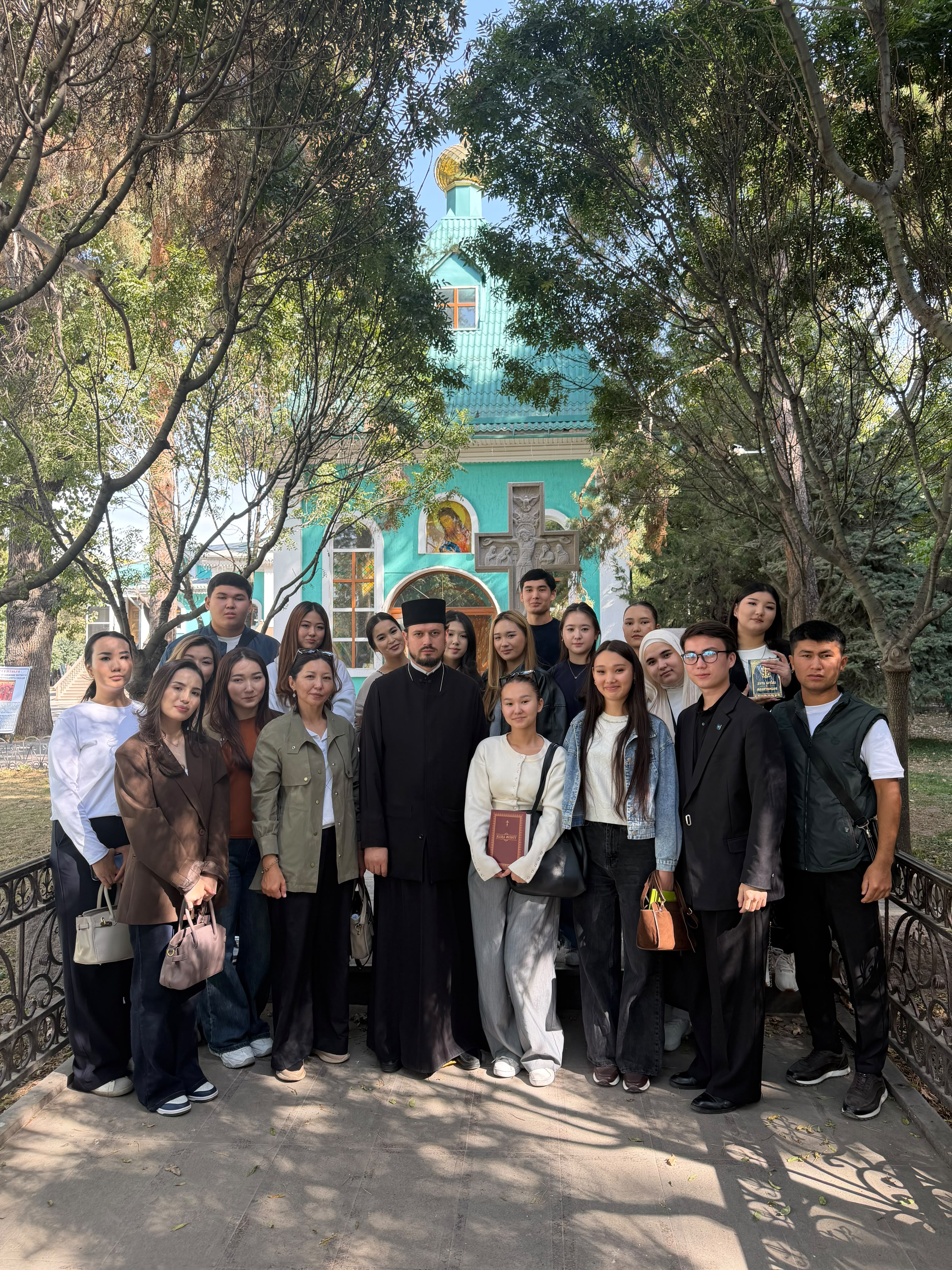
On 18 October 2026, as part of the Day of Spiritual Harmony in the Republic of Kazakhstan, third-year students enrolled in the “6B02203 — Religious Studies” educational programme at the Department of Religious Studies and Cultural Studies, Faculty of Philosophy and Political Science, Al-Farabi Kazakh National University, visited St. Nicholas Cathedral. The visit was organized under the guidance of Zhanna Kantarbayeva, the group’s academic adviser and curator. The initiative aimed to broaden the professional perspectives of future religious studies specialists, promote a culture of interfaith dialogue, and strengthen the principles of mutual respect among representatives of different religious traditions.
The students were warmly welcomed by Father Ioann Levinsky, who introduced them to the history and development of St. Nicholas Cathedral, the distinctive features of its activities, and its spiritual and cultural heritage. During the meeting, the students had the opportunity to learn more about the history of the Orthodox community, understand the cathedral’s significance in the religious life of believers, and explore its historical and cultural treasures.
Particular attention during the discussion was given to the peaceful coexistence of people belonging to different religions, tolerance, mutual understanding, and respect for the religious beliefs of others. The importance of constructive dialogue among representatives of different faiths was emphasized as one of the key conditions for maintaining social harmony and stability in Kazakhstan’s multiconfessional society.
Such visits have considerable educational and professional value for religious studies students. Direct engagement with religious sites and members of the clergy enables students to complement their theoretical knowledge with practical observations, gain a deeper understanding of religious life, and develop a more objective perspective on the role of religious organizations in contemporary society.
In the context of Kazakhstan’s diverse religious traditions, initiatives of this kind contribute to educating young people in the spirit of civic responsibility, tolerance, and respect for the spiritual heritage of different religious communities.
One of the significant outcomes of the visit was the donation of several books by Father Ioann Levinsky to the museum of the Centre for Religious Studies Expertise at the Department of Religious Studies and Cultural Studies. The donated publications will enrich the Centre’s educational, academic, and public outreach resources and will be used in its teaching, research, and museum activities. This gesture symbolized openness to cooperation, mutual respect, and a shared commitment to developing professional dialogue between the academic community and religious organizations.
The event directly aligns with Sustainable Development Goal 16: “Peace, Justice and Strong Institutions.” This goal promotes peaceful and inclusive societies, the strengthening of social cohesion, and the development of institutions founded on dialogue, trust, and respect for human rights. In this context, interfaith engagement serves as an important means of strengthening social solidarity, preventing religion-related conflicts, and fostering a responsible attitude towards religious diversity.
For Al-Farabi Kazakh National University, organizing such initiatives is particularly important. These activities strengthen the connection between university education and practical engagement with society, enhance the professional training of future religious studies specialists, and contribute to the implementation of the university’s principles of academic openness and social responsibility. Cooperation with religious organizations creates opportunities for developing research initiatives, enriching academic and educational collections, and equipping students with the competencies required for expert assessment, analytical work, and educational outreach.
The visit to St. Nicholas Cathedral demonstrated how educational initiatives can bring together academic knowledge, practical experience, and the values of social harmony. Meetings of this kind help future religious studies specialists recognize the importance of professional dialogue, the objective study of religions, and respect for diverse worldviews.
Thus, the event contributed to strengthening interfaith understanding, promoting a culture of tolerance among young people, and advancing the principles of Sustainable Development Goal 16. It also reaffirmed the importance of the educational and public outreach activities of Al-Farabi Kazakh National University in preparing specialists capable of contributing to peace, social harmony, and constructive engagement in contemporary Kazakhstan.
Other news