- Main
- News
- Faculty of Physics and Technology Follows the President’s Address to the People of Kazakhstan
Faculty of Physics and Technology Follows the President’s Address to the People of Kazakhstan
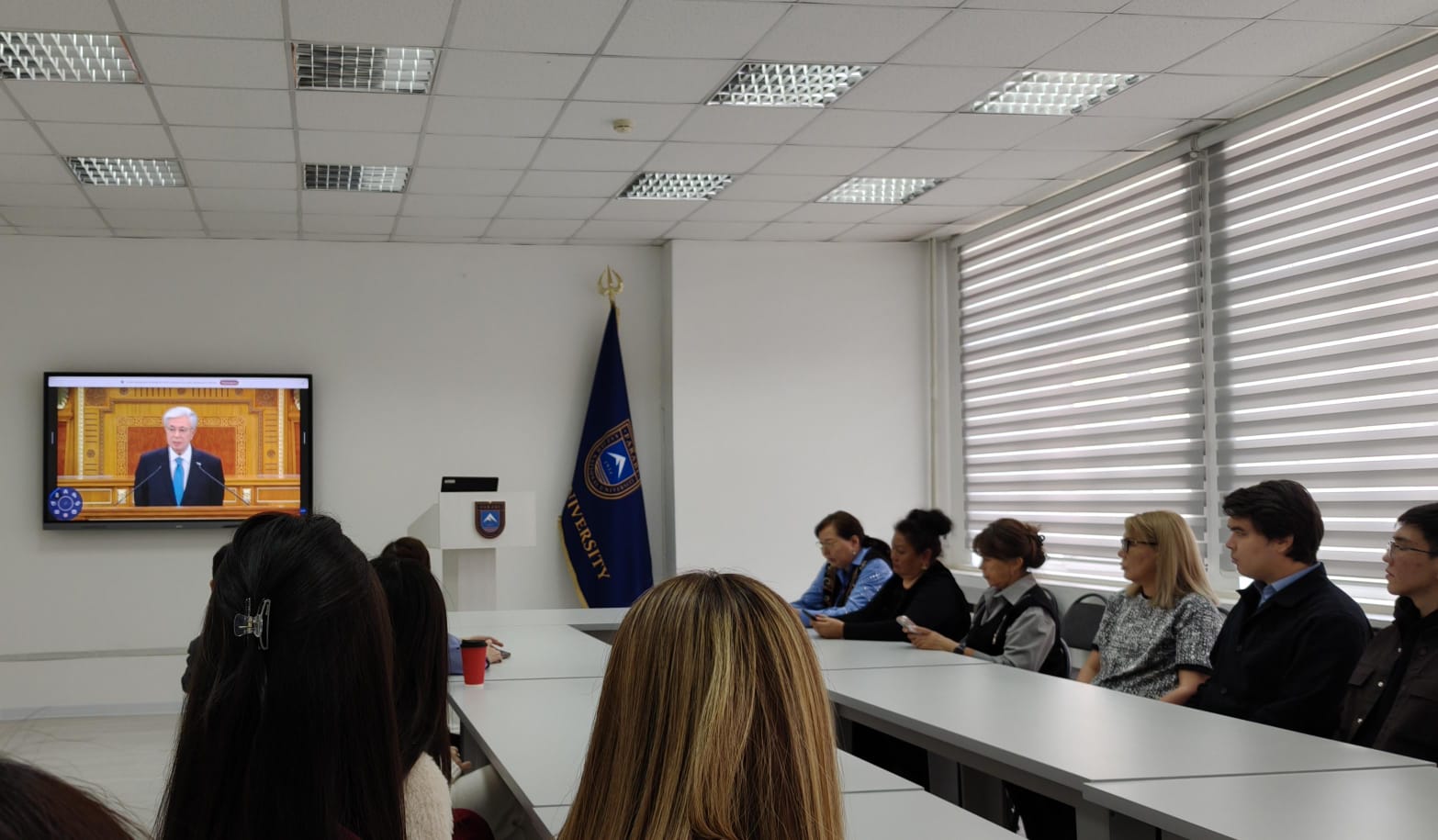
On 28 October 2026, the Faculty of Physics and Technology watched a live broadcast of President Kassym-Jomart Tokayev’s Address to the People of Kazakhstan, “Kazakhstan’s Priority Tasks in a New Historical Cycle.” Dean Nurzada Beisen, the deputy deans and the heads of departments gathered to watch the address. Students followed the broadcast in their classrooms.
Training specialists for nuclear power plants
The section on nuclear energy was of particular relevance to the Faculty. President Tokayev raised the possibility of starting construction of the Balkhash nuclear power plant in 2027 and signing a cooperation agreement to help bring forward the start of construction of the Moyynkum plant. He also emphasised that international partners involved in these projects should help transfer technical expertise, establish high-tech manufacturing in Kazakhstan and train the country’s nuclear workforce.
The Faculty of Physics and Technology helps train specialists for Kazakhstan’s future nuclear power plants through programmes such as Nuclear Physics and Nuclear Engineering. Students study nuclear processes, the interaction of radiation with matter and the principles of reactor operation. Training also covers dosimetry and radiometry, which specialists use to measure radiation levels, assess radiological conditions and monitor the safety of work at nuclear facilities.
The Faculty’s partnership with the Institute of Nuclear Physics supports hands-on training. It provides for laboratory and practical classes using the WWR-K research reactor, as well as professional placements at the Institute. Students can learn how an operating research reactor works, apply what they have learned to measurement and data analysis, and gain practical experience with radiation safety procedures. Master’s and doctoral students use the Institute’s research facilities to carry out work in nuclear physics, materials science and radiation technologies.
Research into how materials respond to radiation is another area of direct relevance to the nuclear industry. Selecting materials for nuclear power systems requires an understanding of how irradiation changes their structure and properties. This work brings together nuclear physics, solid-state physics and materials engineering. For students in the Materials Science and Technology of New Materials programme, it illustrates how laboratory test results can help determine whether a material is suitable for use in a radiation environment.
Modernising the power sector and expanding renewable energy
The address set a goal of achieving a sustained electricity surplus by 2029 and called for an update to the country’s long-term energy balance through 2035. The measures outlined include building and upgrading power plants and transmission lines, developing cleaner coal-fired generation technologies and expanding renewable energy, particularly solar power. These priorities are closely related to several of the Faculty’s teaching and research areas.
The Electric Power Engineering programme covers electricity generation, transmission and consumption. The Thermal Power Engineering programme focuses on thermal processes and on improving the efficiency and reliability of equipment, including through computer modelling. The Energy Systems and Renewable Energy programme prepares specialists to operate and manage energy systems that use renewable sources. These fields complement one another. Bringing new generating capacity online requires efficient equipment, reliable transmission networks and effective management of the power system.
One example of the Faculty’s applied research is plasma treatment of high-ash fuel. Researchers are studying how plasma can improve combustion and reduce harmful emissions. The project applies thermal physics and plasma physics to a practical challenge facing the power sector: using fuel more efficiently while reducing its environmental impact.
Digital technologies in physics and engineering
Another priority relevant to the Faculty was the practical use of digital technologies and artificial intelligence under the Digital Qazaqstan strategy. For students in Cyberphysics, Industrial Electronics and Control Systems, and Radio Engineering, Electronics and Telecommunications, this priority connects with tasks such as modelling physical processes, processing signals and experimental data, designing measurement systems and monitoring equipment. Sensor readings, for example, can help detect when equipment departs from normal operating conditions, while computer models can help predict how it will respond to changes in those conditions.
For the Faculty’s students, the priorities outlined in the address have a direct bearing on their future work. Reliable operation of a nuclear power plant depends in part on accurate measurements and suitable materials. The efficiency of thermal equipment depends on an understanding of heat transfer and combustion, while modern power systems rely on electronics and control technologies. These challenges connect the Faculty’s teaching and research with the needs of Kazakhstan’s energy sector.
Other news