- Main
- AL-FARABI NEWS LETTERS
- University Scientists Develop National Intelligent Computing Infrastructure Using Supercomputers
University Scientists Develop National Intelligent Computing Infrastructure Using Supercomputers
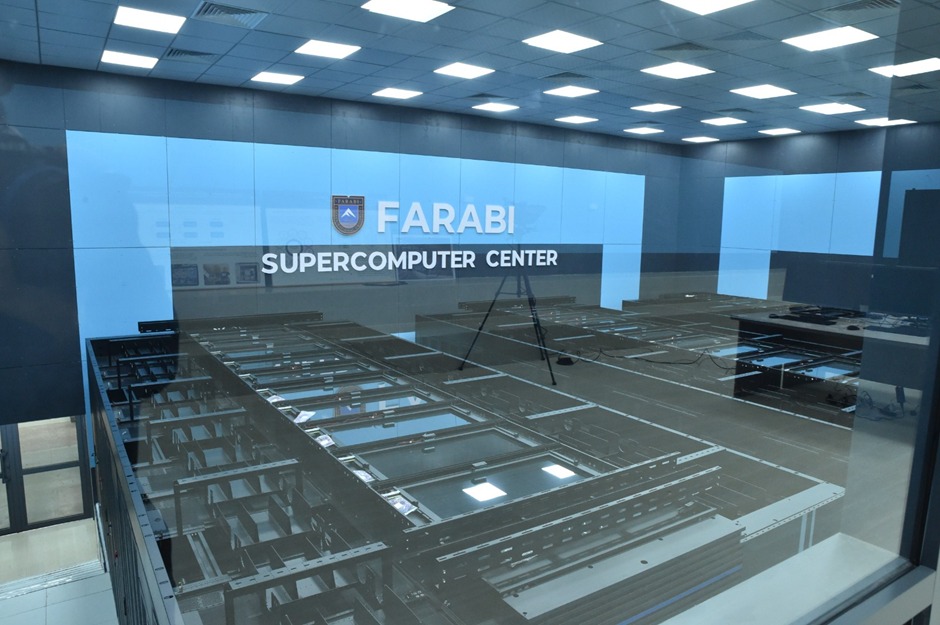
In the era of rapid digital transformation, high-performance computing has become one of the key directions of modern science. Processing large volumes of data, building complex mathematical models, and developing innovative solutions require the use of supercomputing systems. In Kazakhstan, research in supercomputing technologies is actively developing, including studies conducted at Al-Farabi Kazakh National University, where scientists are working on the efficient use of computational resources.
Supercomputing systems are widely applied in bioinformatics, quantum technologies, artificial intelligence, and modeling complex physical processes. One of the most important challenges of modern science is the development of effective big data processing methods. This task has not only technological but also strategic significance for the economic and social development of the country.
The main goal of the research is to create a national infrastructure model for the efficient use of supercomputing technologies. The proposed model integrates data collection, storage, and processing systems into a unified intelligent platform. Within the project, knowledge bases on models and algorithms, automated computational scenarios, and methods for solving complex tasks are being developed.
Special attention is given to bioinformatics and quantum computing directions. Biomedical data processing plays an important role in modern medicine. Analysis of genomic information helps improve early disease diagnosis, develop personalized medicine, and study the impact of environmental factors on human health. The project also aims to create a national scientific data repository.
In addition, the research focuses on developing hybrid models combining classical and quantum computing. When modeling physical processes, physics-informed neural networks (PINN) are studied, allowing physical laws to be integrated into artificial intelligence architectures. This approach ensures high accuracy in solving complex differential equations.
An important feature of the project is the development of technologies for automatic generation of computational scenarios. This helps improve the efficiency of supercomputer resource utilization. The system under development integrates ontologies of subject domains, algorithm descriptions, and software components.
The study also considers the architecture of distributed data storage. It is planned to create a national scientific repository that provides researchers with access to data. This will accelerate scientific research and improve the quality of information analysis.
The implementation of supercomputing technologies will help solve relevant problems in public administration, science, and business. The development of intelligent systems based on artificial intelligence contributes to the optimization of scientific and industrial processes. The practical results of the project are aimed at building an innovative economy and advancing digital technologies.
Research conducted by scientists of Al-Farabi Kazakh National University follows international scientific standards. The results of the project will be published in peer-reviewed scientific journals and presented at international conferences. The participation of young researchers, doctoral students, and master's students in the project implementation is also planned.
Modern world science is rapidly advancing toward hybrid computational architectures. The combination of classical supercomputers and quantum computing opens new perspectives for solving complex scientific and engineering problems. This approach provides high accuracy and computational efficiency.
The research program is consistent with Kazakhstan’s digital science development strategy. The project results will contribute to strengthening the country's scientific potential, developing high-tech industries, and improving the quality of scientific research.
In conclusion, the development of intelligent models for managing supercomputing technologies is an important direction of future science. The research conducted at Al-Farabi Kazakh National University is aimed at creating technological solutions that meet the requirements of the digital era and promote scientific and innovative development.
Other news