A New Detector for Studying Cosmic Rays
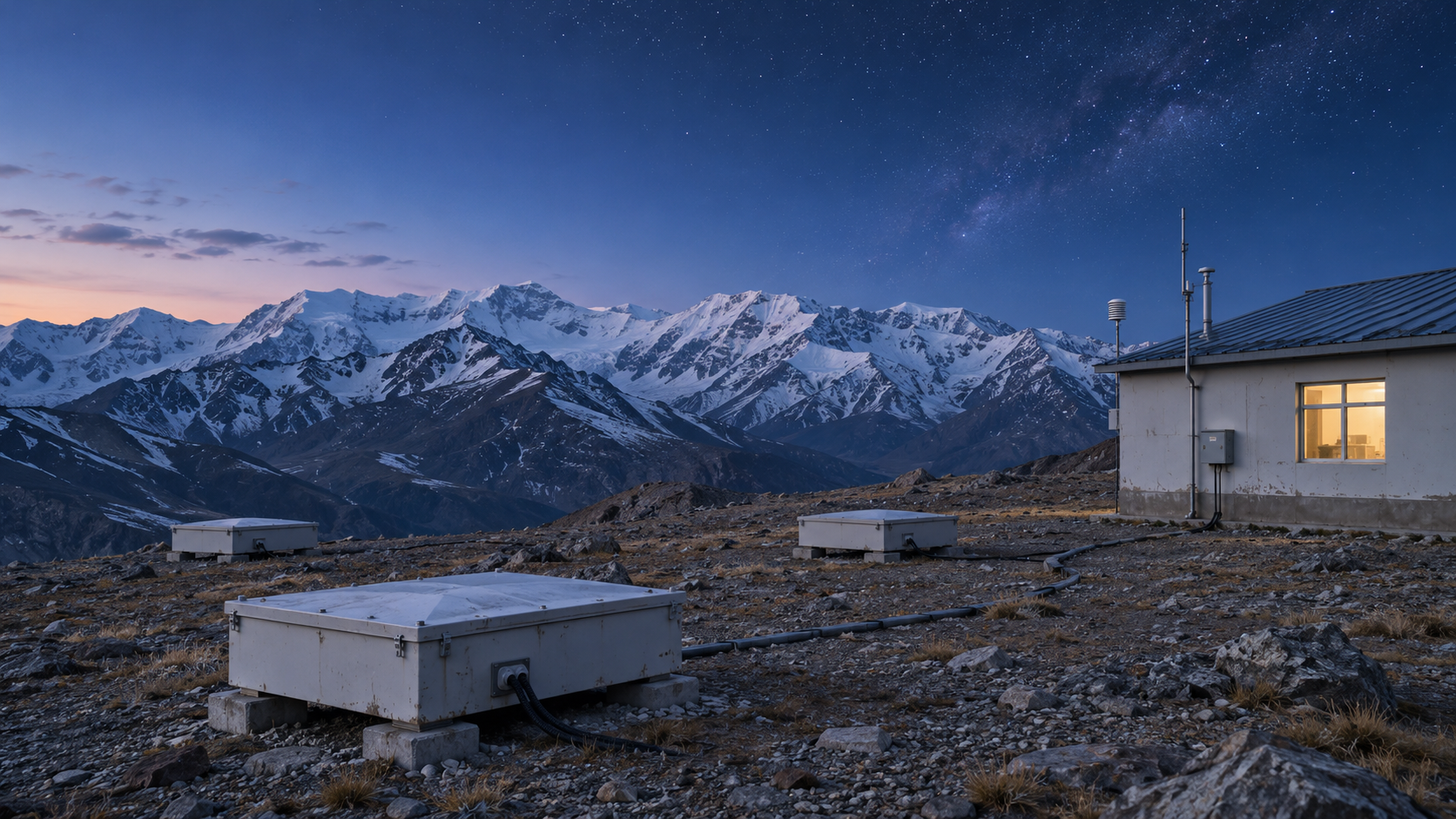
Researchers at Al-Farabi Kazakh National University aim to develop a prototype detector for studying cosmic rays. Experiments in the high-altitude Tian Shan mountains will investigate a change in the energy spectrum known as the “knee.” New measurements will compare the properties of particles produced in the atmosphere and examine their relationship with the composition of primary cosmic radiation.
When a high-energy particle from space enters Earth’s atmosphere, it interacts with the nuclei of air atoms. Secondary particles are produced and undergo further interactions. The resulting cascade is called an extensive air shower. Ground-based detectors record this flow of particles to study its direction, spatial distribution and composition. Observing the secondary particles provides information about the primary cosmic radiation.
A central question concerns the energy spectrum, which describes how the flux of cosmic particles varies with energy. At approximately three petaelectronvolts, the slope of this spectrum changes, producing the feature physicists call the knee. Explaining its nature requires understanding the composition of cosmic rays and how it changes as energy increases. This question guides the choice of measurements.
The experiments will focus on the shower core, the central region close to its axis. Measurements are intended to determine the energy spectra of hadrons in this region. Their energies and distribution help reveal shower structure. Researchers will examine spatial and temporal characteristics together, comparing how different detectors record the same event. Coordinated operation of the measurement systems is essential.
Earlier Tian Shan experiments observed slow absorption of the hadronic component and increased muon counts in some showers. Several hypotheses have been considered to explain these features. One concerns the possible presence of a component with unusual properties in cosmic rays. The new measurements will compare such explanations with experimental data and assess how well they describe the observations.
The main technical task is to expand an ionization-chamber prototype from eight to 24 channels. Each channel contributes to recording signals produced by passing particles. Increasing the number of chambers is intended to provide more detailed information about shower-core structure. The electronics will build on earlier developments. Prototype measurements will be processed and compared with computer simulations to assess detector performance.
In the recording system, high-frequency cables connect detectors to centrally located analogue-to-digital converters. These devices turn electrical signals into digital data for computer processing. A common trigger starts the recording and transfer of information to a computer. This arrangement allows signals from several channels to be examined as one event and used to determine properties of the particle flow.
Cooperation with other air-shower measurement systems is another important element. Timing detectors from “HORIZON-T” and muon detectors will provide additional information about the same shower. Researchers aim to determine its arrival direction, axis position and total electron number. Comparing one event across several systems connects different observable properties and supports a more detailed examination of shower structure.
Computer modelling will support preparation of the experiment. CORSIKA simulates the development of an air shower initiated by a high-energy particle. It will be used to model particle propagation down to the observation level. These calculations help relate measured shower characteristics to the properties of the primary particle. They also allow comparison of interaction models describing processes at high and low energies.
Geant4 will be used to simulate interactions between secondary particles and the detectors. The work begins with a model of the eight-channel prototype, followed by a 24-channel section. Calculations will examine detector geometry and particle response, connecting the shower’s development in the atmosphere with the recorded signal. Comparison with real measurements will be central to assessing the detector’s capabilities.
The ROOT file format is intended for storing and processing measurement data. It will support the accumulation of events recorded across multiple channels and their preparation for analysis. Computing will use the university’s server resources. The research brings together detector construction, electronics development, measurements and data processing, with results from each stage informing subsequent calculations and experiments.
The work builds on Tian Shan’s experience of studying cosmic rays through complementary measurements. These cover the electromagnetic, hadronic and muonic components of extensive air showers. Neutron and gamma-ray observations also provide information about shower properties. Comparing high-altitude measurements and records from different detectors forms the experimental basis of the research, linking several manifestations of the same physical event.
The prototype could provide a foundation for a larger installation. The long-term aim is to extend experimental capabilities for studying cosmic rays between one and 1,000 petaelectronvolts. Initial work will concentrate on developing the 24-channel system, checking its operation and collecting preliminary data. These measurements will help refine the design of the future installation and the research methods.
The results are intended for further cosmic-ray research and for involving students in experimental work. The detector and data acquisition system will allow young specialists to gain experience with instrumentation, computer simulations and measurement processing. Scientific findings are to be published in peer-reviewed journals and presented at international and domestic conferences.
Other news