- Main
- AL-FARABI NEWS LETTERS
- Sustainable Development of Kazakhstan’s Agro-Industrial Complex under Climate Change — Macroeconomic Analysis and Adaptation Strategy Based on Research Conducted by Scientists of Al-Farabi Kazakh National University
Sustainable Development of Kazakhstan’s Agro-Industrial Complex under Climate Change — Macroeconomic Analysis and Adaptation Strategy Based on Research Conducted by Scientists of Al-Farabi Kazakh National University
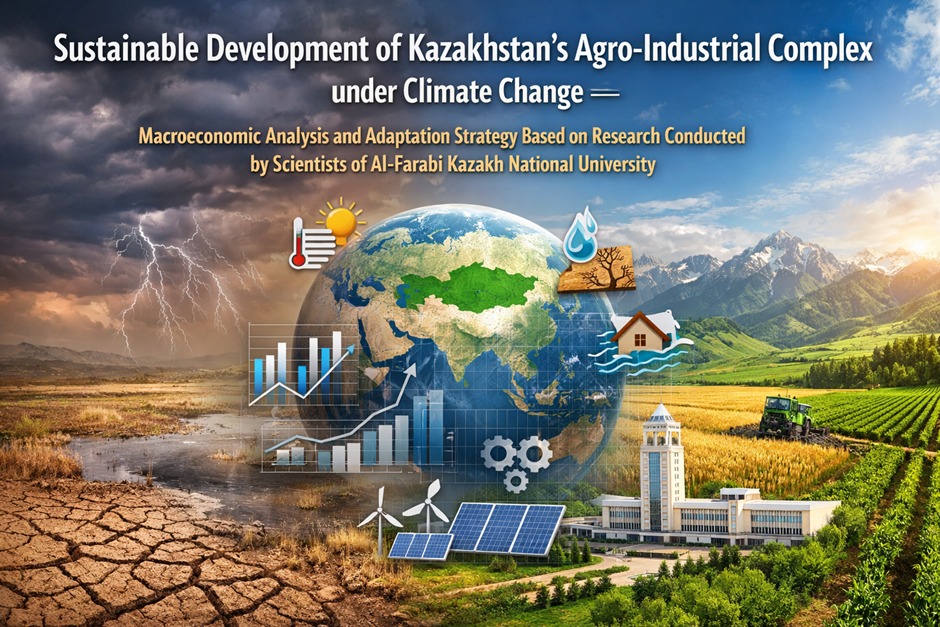
In the modern world, climate change has become one of the key challenges for sustainable economic development. This issue is especially important for the agricultural sector, which directly depends on natural and climatic conditions. The increasing frequency of extreme weather events, including droughts, floods, and wildfires, significantly affects agricultural productivity, potentially leading to higher food prices and macroeconomic instability.
In this context, the sustainable development of Kazakhstan’s agro-industrial complex has strategic importance. At Al-Farabi Kazakh National University, a fundamental scientific project is being implemented aimed at comprehensive research of the long-term macroeconomic consequences of climate change and the development of an adaptation strategy for the country’s agricultural sector. Scientists of the university are working on integrating economic analysis, environmental research, and modern mathematical modeling methods.
Kazakhstan is a country with vast territory and diverse climatic zones. The southern regions are characterized by arid conditions, while the northern territories belong to forest-steppe zones. Such geographical diversity makes the agricultural sector particularly vulnerable to climate change. According to international researchers, climate risks may intensify in the long term, leading to water resource scarcity and declining crop productivity.
The main objective of the project is to study the macroeconomic consequences of climate change for Kazakhstan’s economy, particularly for the agro-industrial sector, and to develop effective adaptation mechanisms. The research applies stochastic modeling, panel regression analysis, and computable general equilibrium (CGE) models. These approaches allow quantitative assessment of climate factors’ impact on labor productivity, crop yields, employment, and income levels.
The study analyzes data from various agricultural regions of Kazakhstan. Official statistical materials from the Bureau of National Statistics, international databases, and scientific literature are used. Considering regional differences and temporal variations, predictive assessments of agro-industrial complex development under changing climate conditions are formed.
To evaluate resource efficiency, Data Envelopment Analysis (DEA) and Stochastic Frontier Analysis (SFA) methods are applied. These tools help determine the efficiency of water, fertilizer, and other production resource utilization, as well as identify potential reserves for productivity improvement.
Preliminary research results indicate that climate change may negatively affect Kazakhstan’s agricultural export potential. This may lead to deterioration of the trade balance and increased macroeconomic risks. The growing frequency of droughts and floods increases production costs and contributes to food price instability. Such processes may exacerbate socio-economic inequality and affect the living standards of rural populations.
As part of the project, a climate risk map is being developed. This map will help identify the most vulnerable agricultural regions of the country and provide recommendations for adaptation measures. Additionally, an Agricultural Adaptation Atlas of Kazakhstan is being created, considering regional climate characteristics, water resource conditions, soil fertility, and production potential.
An important element of the project’s scientific novelty is the introduction of a stochastic economic growth model that accounts for climate factors. This model enables quantitative assessment of climate change impacts on labor productivity and overall economic growth. Based on the obtained data, long-term macroeconomic scenario projections for the agro-industrial complex of Kazakhstan will be developed.
Special attention is given to the efficient use of water resources and fertilizers. Resource optimization methods help reduce production costs and environmental pressure. Investments in sustainable agricultural technologies may contribute to macroeconomic stability and reduce food price fluctuations.
The social significance of the project is also high. The research examines the impact of climate change on employment, income levels, and quality of life. Socio-economic risks in rural regions are assessed. Environmental risks are also analyzed, including air pollution and the possibility of exceeding permissible concentrations of heavy metals.
The project considers Kazakhstan’s agro-industrial complex as a potential economic growth point. Developing a climate strategy based on sustainable development principles will not only ensure national food security but also expand the export potential of agricultural products.
According to researchers, timely implementation of adaptation measures can reduce economic losses and ensure long-term sustainability of agriculture. The project results can be used in shaping state policy in agriculture, environmental protection, and economic planning.
The project is being implemented during 2025–2027. At the end of the three-year study, it is planned to develop a scientifically justified climate strategy for Kazakhstan’s agro-industrial complex. Publication of research papers in international peer-reviewed journals and development of practical recommendations for public administration are also expected.
It should be noted that this research is conducted by scientists of Al-Farabi Kazakh National University. The work is aimed at developing the country’s scientific potential, improving climate risk analysis methods, and supporting sustainable economic development.
In conclusion, this project represents a comprehensive scientific study aimed at solving strategically important development tasks for Kazakhstan. Analysis of the long-term macroeconomic consequences of climate change and development of adaptation strategies is an important step toward ensuring food security and sustainable economic growth. Only scientifically based solutions can provide effective adaptation to climate challenges and create a solid foundation for Kazakhstan’s future development.
Other news