- Main
- AL-FARABI NEWS LETTERS
- KazNU Scientists Uncover the Historical-Legal Nature of POW Camps in the Kazakh SSR
KazNU Scientists Uncover the Historical-Legal Nature of POW Camps in the Kazakh SSR
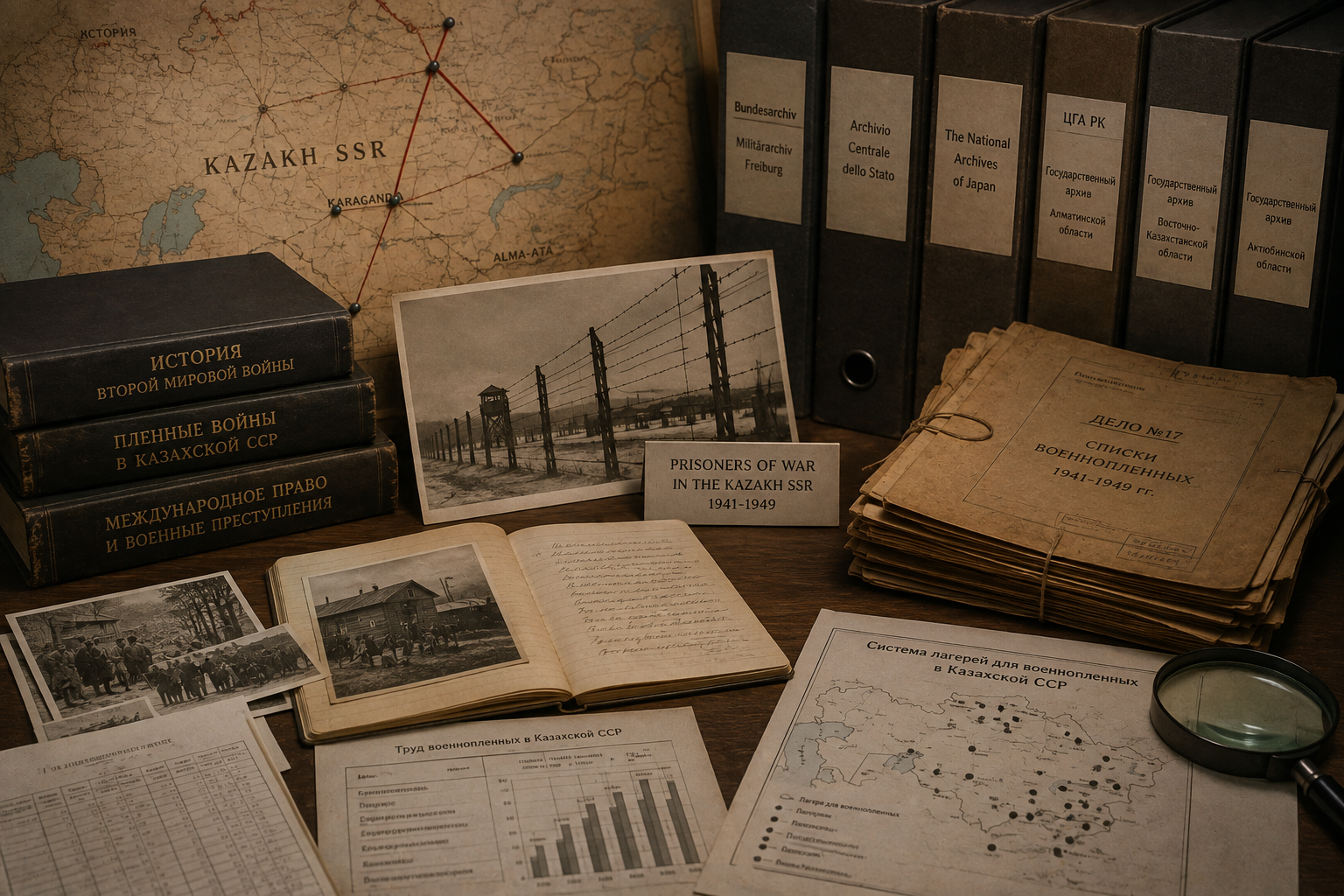
Archival materials on the history of World War II have not yet been fully brought into scholarly circulation. Kazakhstani historiography has largely limited the study of prisoners of war to questions of camp system organization, labor use, and ideological education, while aspects such as prisoners' perception of camp reality, the transformation of their value systems, intercultural communication, and their reintegration into post-war society have remained unexplored. The captivity of Germans and other nationalities has fallen outside the scope of domestic researchers, whose work is dominated by general studies of Japanese POWs.
The project's goal is an interdisciplinary historical-legal study of the history of World War II prisoners of war in the Kazakh SSR and the regional characteristics of their detention. The research focuses on Germans, Japanese, and Italians — nationals of the three states that made up the majority of prisoners held on the territory of the Kazakh SSR. The project is the first in domestic historiography to apply interdisciplinary approaches to studying the theory and practice of Soviet captivity and internment.
The research comprises ten tasks: interpreting scholarly approaches to the POW issue across different historical periods; identifying new archival materials on detention conditions and camp life organization; determining prisoners' contribution to the Kazakh SSR economy based on statistical data; revealing the characteristics of daily life within the camp system; studying prisoners' adaptation to camp life and their reception of Soviet doctrines; forming a prosopographic profile of prisoners' numbers and composition; analyzing the formation of the detention system; determining the political-legal regulation of the internment regime; examining punishment methods and ideological education in the camps; and uncovering the mechanisms for resolving the repatriation issue in independent Kazakhstan.
The research combines comparative-historical, systemic, historical-statistical, historical-chronological, and prosopographic methods, along with a comparative-legal approach and legal modeling. Data will be collected from Germany's Federal and Military Archives (Koblenz, Freiburg), Italy's Central State Archive (Rome), Japan's National Archives (Tokyo), as well as city, regional, and district archives in the Almaty, East Kazakhstan, and Aktobe regions. The project's lead researcher has experience working with the holdings of the Presidential Archive of the Republic of Kazakhstan, while a doctoral student on the project completed a research fellowship at the University of Tokyo and established connections with Japanese scholars studying POW history.
The project will produce at least 2 articles in journals ranked Q1-Q2 in Web of Science or with a CiteScore percentile of at least 50 in Scopus, at least 4 articles in journals recommended by KOKSON (one in a multidisciplinary category), a compiled dataset, a copyright certificate, and the training of at least 1 PhD candidate. The project's findings will be applicable in university textbooks and scholarly works, and will assist the international community in locating burial sites of those who died during the war.
Spanning 36 months (2025-2027), the project will generate new knowledge at the intersection of history and law, laying the foundation for international scientific cooperation with Germany, Japan, and Italy.
Other news