Study of the heritage of Kazakh steppe thinkers in Russian manuscript collections
Scientists from the Department of Religious Studies and Cultural Studies at the Faculty of Philosophy and Political Science of Al-Farabi Kazakh National University are actively continuing their research work at the international level. In this regard, senior researcher of the department, PhD, Associate Professor Azamat Shutbaevich Zhamashev made a special scientific trip to leading scientific centers and large manuscript collections of the Russian Federation. The visit was carried out within the framework of the grant funding project AP22686474 "Anthology of Arabic-Language Sources of Kazakh Thinkers in Foreign Archives," in order to enrich the source base of the monograph currently in preparation, analyze medieval written artifacts, and strengthen international scientific ties.
During the scientific trip, the researcher conducted a comprehensive search in the rare collections of the most prestigious academic institutions and libraries in Saint Petersburg, Moscow, and Kazan. In particular, these included the Institute of Oriental Manuscripts of the Russian Academy of Sciences (IVR RAN) and the National Library of Russia (RNB) in Saint Petersburg; the Russian State Library (RGB – former USSR State Library), the Institute of Oriental Studies of the Russian Academy of Sciences (IV RAN), and the Scientific Library of Lomonosov Moscow State University (NB MGU) in Moscow; and the Russian Islamic Institute (RII) in Kazan. In Moscow, the Russian State Library (RGB - the State Library of the former USSR), the Institute of Oriental Studies of the Russian Academy of Sciences (IV RAS) and the Scientific Library of the Lomonosov Moscow State University (NBU MGU);
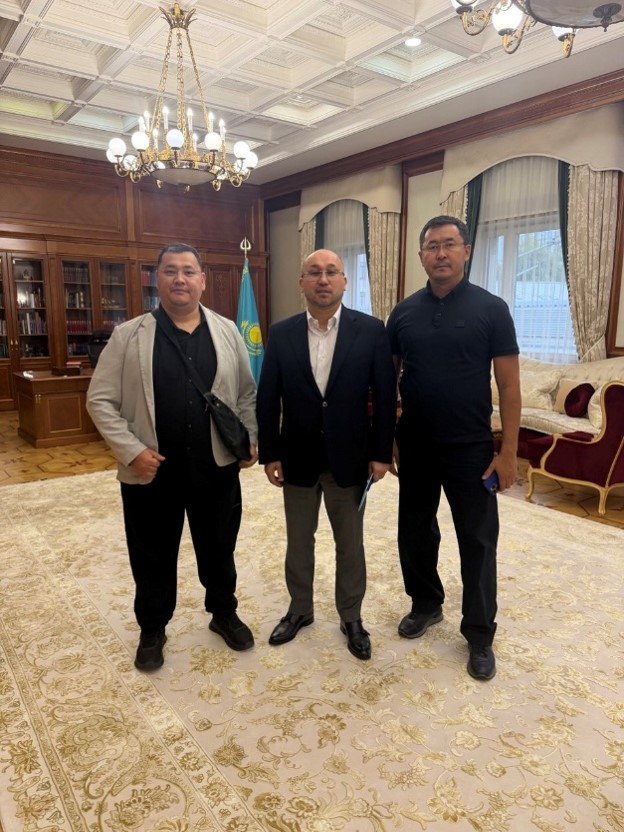
The visit was not limited to archival research, but also included substantive meetings with the Ambassador Extraordinary and Plenipotentiary of Kazakhstan to Russia, Dauren Askerbekuly Abayev, as well as local manuscript specialists and scholars. During the meetings, issues regarding the inventory of national heritage and the development of future joint scientific projects were discussed.
Furthermore, Yernar Kalmakhanuly Mazhen, a doctoral candidate at the Department of Religious and Cultural Studies, conducted comprehensive research in Russian scientific centers within the framework of his doctoral dissertation titled "The Problem of Religion in the Works of Zhyraus of the 15th–18th Centuries," studying rare manuscripts and historical texts.
Among the artifacts identified during the research trip, unique records were found that stand out for their intrinsic value. One of the oldest manuscripts found in the collections is an ancient copy of the dictionary "al-Sihah" by the linguist and scholar Ismail al-Jawhari al-Farabi, dated 1124, kept at Kazan Federal University. Along with this ancient work, the 1174–1175 copy of Burhanuddin Ahmad al-Farabi's "Zalla al-Qari," dedicated to errors in the recitation of the Quran, found in the Bukhara collection of the Asian Museum in Saint Petersburg, also leads the ranks of valuable early medieval heritage.
Among the studied manuscripts, al-Jawhari al-Farabi's famous dictionary "al-Sihah fi al-Lugha," considered unparalleled in Arabic lexicography, was recognized as the work with the highest number of recorded copies. More than 14 copies of it, transcribed in different centuries (12th–18th centuries) and kept in Russian collections, have been analyzed; it was established that the 1487 copy of this work in the city of Kazan is one of the largest complete copies, totaling 819 pages. In addition, one of the most extensive treatises on medieval law and jurisprudence was discovered—a 433-page copy of the work "Ghayat al-Bayan" by Abu Hanifa Qawamuddin al-Itqani al-Farabi, copied in 1444.
Scientific research was not limited to the Otrar region but also encompassed the heritage of thinkers from the Syr Darya and Turkestan regions. For example, Tajuddin al-Jandi's treatise on scientific debate and ethics, Dawud al-Turkistani's work "Jami' al-Qawa'id," which contains logical rules, and Jamal al-Qarshi's unique work "Mulhaqat al-Surah," dedicated to the region's history, were re-evaluated from a textual perspective. In particular, information regarding the authentic features of the rare treatises of the great thinker Abu Nasr al-Farabi—namely, "Views of the People of the Virtuous City," "al-Jam' bayna ra'yay al-hakimayn," which combines the philosophies of Plato and Aristotle, and his treatise on the rulings of the stars—has been supplemented.
As a result of the international research trip, textual and paleographic descriptions of a total of 60 valuable manuscript copies related to national history and spirituality were compiled and included in the forthcoming monograph and anthology. This study highlights the role of the thinkers of the Kazakh steppe in the medieval scientific and intellectual civilization from a new perspective, making a significant contribution to strengthening the prestige of Al-Farabi KazNU in the international scientific arena.
Azamat Zhamashev
Senior Researcher at the Department of Religious and Cultural Studies
Other news