A computer model for cleaning up groundwater
A team including researchers from Al-Farabi Kazakh National University has proposed adapting oil reservoir software to plan the clean-up of groundwater. The model would estimate how contaminants and flushing solutions move through soil and water-bearing rock. The research was planned for 2024–2026, with experiments at KazNU and the French Geological Survey (BRGM) to check the calculations.
The condition of an aquifer matters to communities that draw water from underground sources. Engineers planning treatment need to know how far a pollutant has spread and whether a flushing solution can reach it. A model would use data on soil, the contaminant and groundwater flow to help them compare options and identify where pollution might remain.
How pollutants move through the ground
An aquifer is a layer of rock or sediment that holds water and lets it move through pores and fractures. Some petroleum products and organic solvents can form a separate liquid phase when they enter the ground. Liquids lighter than water can collect near the water table. Denser contaminants can travel deeper. The position of a contaminated area depends on the properties of the liquid and on the structure and permeability of the surrounding material.
Small amounts of a contaminant can remain trapped in the gaps between grains after most of the liquid has been removed. Components that dissolve in water can travel with the groundwater. Differences between layers of soil and rock can make fluids move quickly in one place and much more slowly nearby. Accounting for these differences helps researchers estimate how much of the contaminated area a flushing solution could reach.
One approach under study is treatment in place. A water-based solution can be introduced into the ground to displace some of the contaminating liquid. The composition of the solution and the pressure at which it enters the ground affect how it spreads through the pores. Simulating those conditions helps researchers choose which solutions and delivery pressures to test in the laboratory.
Adapting the reservoir software
The proposed model would extend KMGEsim, originally developed to simulate chemical methods for increasing oil recovery. It treats water, the contaminating liquid and any gas as separate phases. They can move through the same pore space and affect the flow of one another. The adaptation will account for the permeability of the soil and the limits on injection pressure in aquifers.
One planned addition is a way to describe how polymer solutions move. A solution’s viscosity, or resistance to flow, can change with the conditions in which it flows. Solutions that behave this way are called non-Newtonian fluids. Changes in viscosity affect the way a flushing solution travels through soil and displaces the contaminant. The model will estimate viscosity using the flow conditions in each part of the aquifer.
The calculations are also intended to account for chemical reactions and the effects of microorganisms. The model would represent sorption, a process that can retain some contaminant components on soil particles. Including these processes helps estimate how the composition and distribution of substances change over time. The project also proposes three-dimensional visualisations to show where the fluids travel and where contamination remains concentrated.
Laboratory tests
The KazNU team plans to run tests in a soil-filled column 40 centimetres long, with an internal diameter of 4 centimetres. Researchers would pass liquid through it and measure the difference in pressure between its ends and the mass of the liquid collected at the outlet. Comparing what goes into the column with what comes out would help estimate how much of the contaminant has been removed and how much remains in the pores.
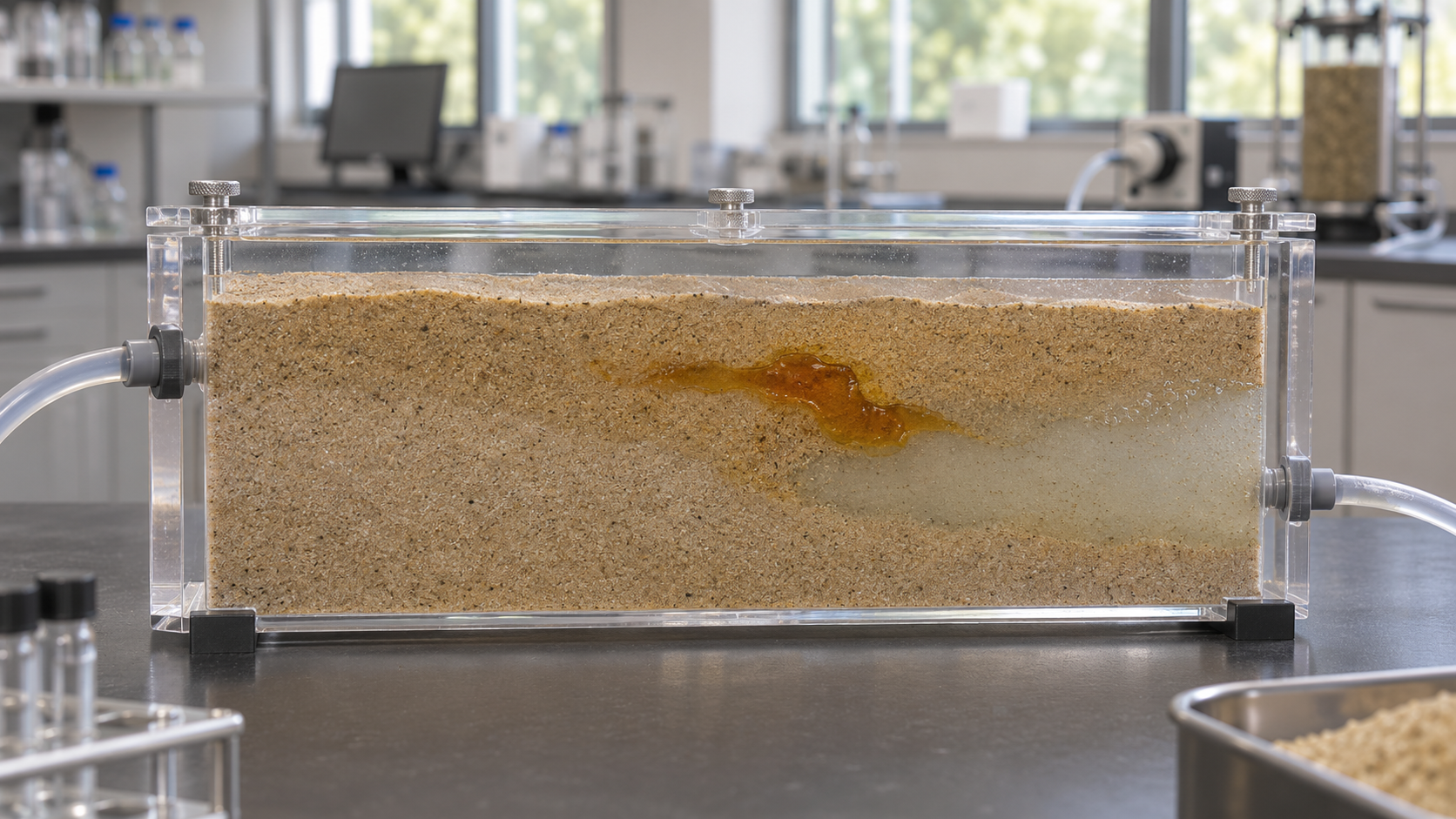
At BRGM’s laboratory in Orléans, the team plans to use a two-dimensional tank. Inlets at several points allow researchers to vary the injection pressure and the composition of the solution. The tank can be used to study how a solution spreads through soil with different properties and how much contaminant it displaces. The team intends to compare those observations with calculations for the same conditions.
A later stage would use BRGM’s larger three-dimensional PRIME facility. It can accommodate more soil and allows sampling of water, gas and solid material at several points. The team would use these measurements to see how well the model performs at a larger scale and compare the results with those from the column tests.
Using the model to assess treatment options
The laboratory measurements would help the team set the model’s parameters. The plan is to compare early calculations with results from established programs and with observations from the experiments. The researchers then intend to extend the simulations to field-scale scenarios and check them against information from actual sites. These comparisons would show where the model describes the movement of groundwater and pollutants well and where the parameters need refinement.
Once tested, the simulator could help specialists compare ways of treating contaminated sites. Calculations for a particular site would use details of the aquifer’s structure, the pollutant’s properties and the local flow of groundwater. The simulations could help identify where a flushing solution is likely to reach, where access is more difficult and where further measurements are needed. The team plans to report the experimental data and modelling results in scientific publications.
Other news